Size the light to the floor of your tent first and to the watts second. For a 4 × 4 ft tent our 400W double switch or the 500W PT are the right size. A 2 × 2 ft shelf of seedlings needs a pair of 2 ft strips, and a 7 × 7 ft room calls for the 800W PT8000 or the 840W. Then hang the light close, give it a timer, and let the plants tell you whether you got it right.
Our lights run from 40 watts to 840 watts, and the question we hear most is a simple one: which of them fits my space? The honest answer has three parts. The light has to cover the floor you grow on. It has to hang at a height where enough of it reaches the leaves. And it has to run long enough each day to give the plants what they need. Get those three right and the color of the diodes matters far less than most people think.
This guide walks through all three with numbers you can check. Extension services test lights on real seedlings, and their advice shapes the numbers that follow.
Think of light as a daily amount, not a brightness
Brightness is what you see when you switch a lamp on. Plants care about something else: how much usable light lands on a leaf over a whole day. Extension horticulturists call that the daily light integral, or DLI, and the University of New Hampshire explains it with a picture that sticks.
A plant’s need for light can be thought of like a bucket being filled with water, where the different light sources are different hoses.
A strong hose fills the bucket in a few hours. A weak one needs most of the day. That is why a fixture that looks bright to you can still leave seedlings thin and stretched, and why a fixture of the same wattage can do better hung lower. The same fact sheet puts numbers on it.
The point is not that fluorescent tubes are useless. The point is that the plant counts the total. A stronger light, or the same light hung closer, gets there in fewer hours.
A tomato seedling may have its light bucket filled for the day in just five hours in full sun, whereas the same plant may need 22 hours of a fluorescent light, just because there are so many more photons coming out of the sun every second than out of the fluorescent light.
Match the footprint of your tent
Every SZHLUX bar light states the floor area it is built to cover. That number is where to start, because a light sized for a bigger floor wastes power on the walls of a small tent, and a light sized for a smaller floor leaves dim corners in a big one. Here are common spaces and the light we would put in each. Coverage figures are the ones printed on our own product notes.
| Point | Light | Power draw | Stated coverage | Worth knowing |
|---|---|---|---|---|
| 2 × 2 ft shelf or cabinet | LED grow light strips, 2 ft | 40W per strip | Shelf length, up to 4 strips in a row | Seedlings, herbs, house plants |
| 4 × 4 ft tent | 400W LED grow light, double switch | 400W | 4 × 4 ft | 864 LEDs, 2.9 µmol/J |
| 4 × 4 ft tent, 5 × 5 ft in veg | 500W LED grow light PT | 500W | 4 × 4 ft bloom, 5 × 5 ft veg | 1,056 LEDs, 2.7 µmol/J, heat steps |
| 4 × 6 ft tent | 620W LED grow light | 620W | 4 × 6 ft | 1,944 LEDs, four dimmer modes |
| 7 × 7 ft room | 800W LED grow light PT8000 | 800W | 7 × 7 ft | 2,304 LEDs, UV and IR, heat steps |
The two lights we suggest most often for a 4 × 4 ft tent
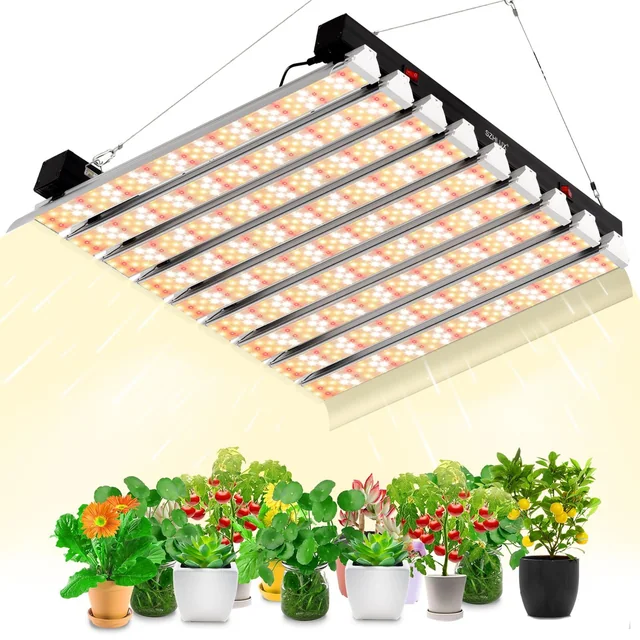
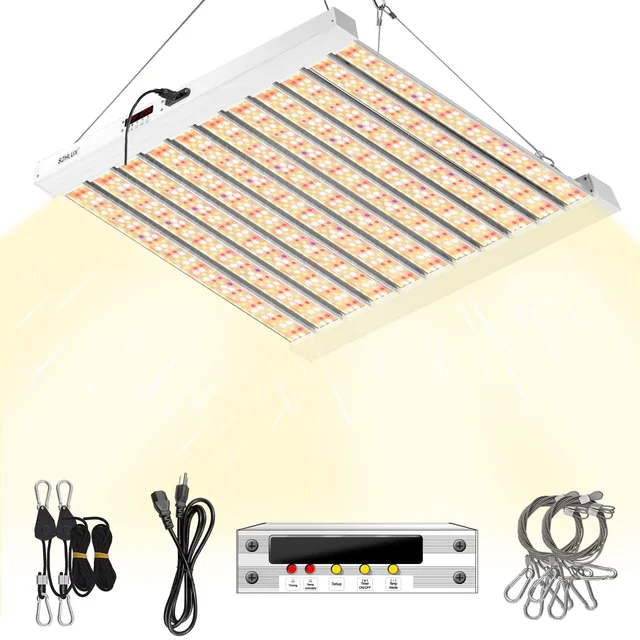
The 400W and the 500W PT cover the same 4 × 4 ft bloom footprint, and they differ in how you control them.
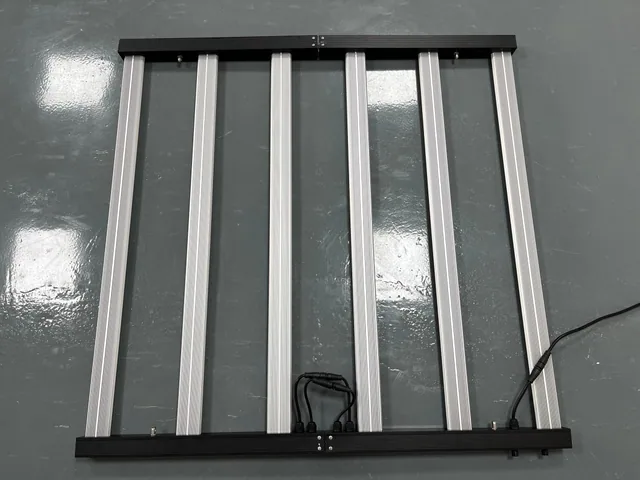
The 400W has two switches, one that runs three bars and one that runs all six, so you get a low step for seedlings and a full step for everything else.
The 500W PT has no dial. It has a timer button and a temperature sensor, and it switches bars off on its own as the tent heats up. Our product notes give the steps: at 86°F eight bars stay on, at 91°F six bars stay on, and at 96°F the light turns off. That is a safety net for a warm room, and it is also why we would not pick the PT for a cold basement where you want full power all the time.
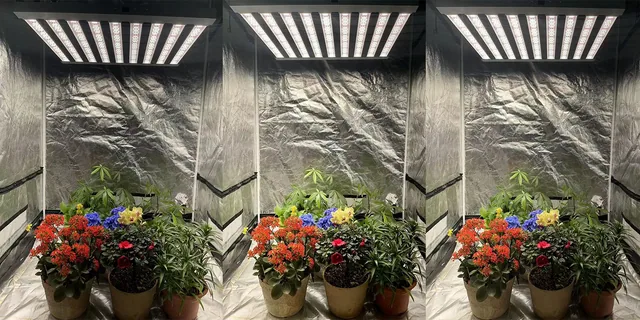
For a rectangular 4 × 6 ft tent the 620W is the better fit, because its stated footprint is 4 × 6 ft and it carries 1,944 diodes. Above that, the 800W PT8000 and the 840W cover a 7 × 7 ft room. Both can run on a timer.
The 840W adds four dimmer modes and can link to other lights by network cable, which matters once a room holds more than one fixture. You can compare every one of them side by side in our grow and shop lights.
Hang it close enough
A light delivers far less at the leaves than it does at the diodes, and the loss grows fast with distance. That is the single most common reason a correctly sized light disappoints. Iowa State University gives the range that suits most LED fixtures.
LED can be 12 to 24 inches away in most cases.
Start near the top of that range for young seedlings and lower the light as the canopy fills in. Hang a bar light on adjustable rope hangers, and you can raise or lower it a few inches at a time instead of rebuilding the setup. The strips can hang by rope, clip to a ceiling or tie to a stand with cable ties.
The New Hampshire fact sheet measured how much this matters. One LED light bar needed eight hours a day to reach the target when it hung 8 inches above the crop, and sixteen hours when it hung 20 inches above. Same light, same plants, twice the electricity. The practical advice that follows is simple enough to pin above the tent.
Keeping the lights close to the plants and raising the lights as the plants grow is a technique to get the most light out of our fixtures.
Close has a limit. Leaves that bleach, scorch or curl at the edges are telling you the light is too near, and the fix is to raise it a few inches. Our bar lights are fanless with aluminum shells, so they run quiet, but the canopy right under a high-watt light still runs warm. A small fan moving air across the leaves helps more than any setting on the light.
Give it hours, and give it a night
Plants need darkness as well as light. A dark period lets many of them flower and fruit on schedule, and running a light around the clock wastes power without helping. Iowa State puts the working range plainly.
For home gardeners, it is best to have light on for as little as 10 hours and no more than 16 hours a day.
| Point | What it means | How our lights handle it |
|---|---|---|
| Seedlings and leafy growth | Toward the long end of the range | Run full power on the 400W, or the white channel on the 620W and 840W |
| Flowering and fruiting | A steady schedule with a real night | Use the built-in timer on the PT lights, the 620W and the 840W |
| House plants on a shelf | The middle of the range | Plug the 2 ft strips into an outlet timer |
Every PT light and our 620W and 840W have a timer on the fixture. The 400W double switch, the 720W foldable and the strips do not, so plug them into a simple outlet timer. Whatever you use, keep the schedule steady. Plants respond to the length of the night as much as to the length of the day, and a light that comes on at random times confuses that signal.
Read the plants before you buy more light
Without a light meter, the plants are your meter. A seedling that does not get enough light grows tall and thin and leans toward the lamp, with long gaps between its leaves. The New Hampshire fact sheet adds a warning worth knowing before you fix it.
Once a stem is stretched, adding light will not shrink it back down, but adding light may prevent further stretch.
So act early. If seedlings start to stretch, lower the light first, then add hours, and only then think about a bigger fixture. If leaves bleach or the plants stay unusually short and dark, go the other way and raise the light. Iowa State lists the same signs and the same fixes in its own table, and it is the order we would follow: distance first, hours second, hardware last.
A soil moisture meter helps here as well. Plants under strong light dry out faster, and a stressed plant that is simply thirsty can look like a plant that wants more light.
Do you need a grow light at all?
Not for seedlings on a rack. A plain 4 ft LED shop light with 3,000 lumens or more, hung 18 inches above them for 14 hours a day, raises them well.
Extension staff hear the question often, and their answer surprises people who expect a sales pitch for special diodes.
When Extension gets questions about light from people growing seedlings indoors, often the question is about Quality (“should I use a grow light instead of a shop light?”) when the focus should really be on quantity, or DLI.
Iowa State even gives a recipe for a plain LED shop light: a standard 4-foot fixture with daylight color, hung 18 inches from the foliage, with at least 3,000 lumens and 14 hours on. Our 4 ft shop lights are built for garages and basements, but they clear that bar. The 60W model gives 8,700 lumens at 5000K, and the 42W V shape gives 6,300 lumens. They are a sound choice for starting seedlings on a rack in spring, and they light the garage the rest of the year.
They are not the right choice for a tent of flowering plants. Shop lights carry no deep red or infrared diodes, and they switch on and off with no dimmer or timer. Most of our grow lights add deep red and infrared diodes to the white ones, which the bloom stage uses well.
For a seed rack or a shelf of house plants
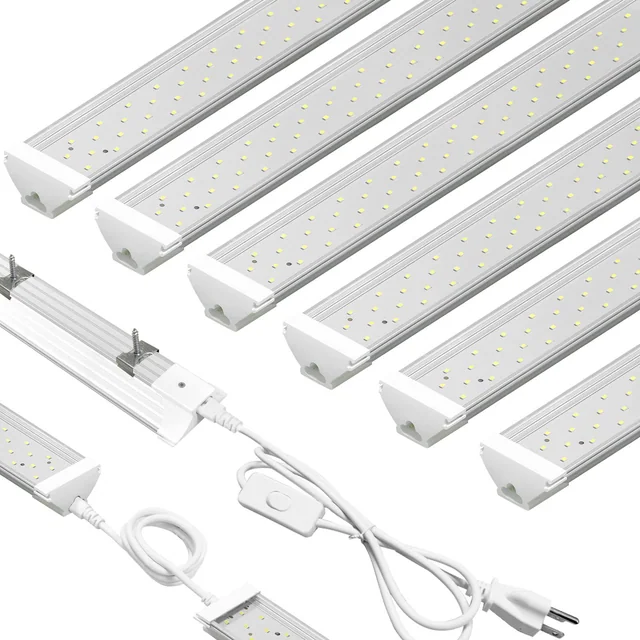
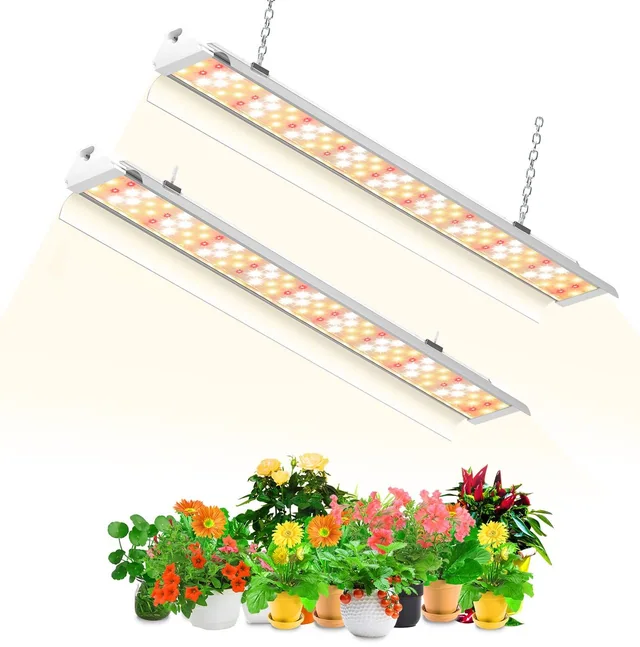
Linking several lights safely
Strips and shop lights link end to end so one cord can feed a whole shelf. Our 2 ft strips and the 60W shop lights link up to four in a row with the cords in the box, and the limit is a hard one. Connect the lights while the power is off, plug only one end of the chain into the wall, and never feed power into both ends. Our product notes spell this out because a second power cord on the far end shorts the chain.
The larger bar lights work differently. The 620W and 840W link by network cable so several fixtures dim and time together, which is useful in a room with two or three lights. Each fixture still plugs into its own outlet.
What our lights will not do
We would rather you buy the right light than the biggest one, so here is where each falls short. The strips have no dimmer and do not work with a dimmer switch. The 400W double switch has two steps, not a dial.
The PT lights dim by temperature, not by hand. The 720W foldable has a dimmer and no network link to other fixtures in its specification, so it suits a grower who moves one light between tents more than a room of matched fixtures. None of our lights replace ventilation, and none of them make up for a light hung two feet too high.
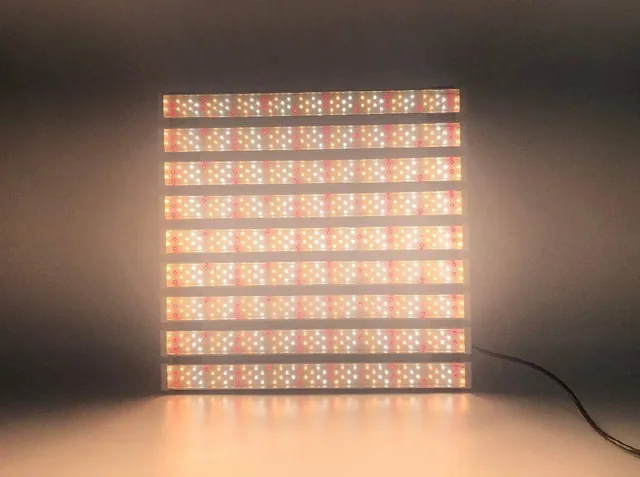
If you are not sure, write to us with the size of your space and what you grow. The full range of lights sits on one page with filters for type and power, and our light planner narrows it to your floor in two clicks.
Sources
- University of New Hampshire Extension. Growing Seedlings Under Lights. Read 27 October 2026.
- Iowa State University Extension and Outreach. How to Set Up Supplemental Lights for Indoor Plants. Read 27 October 2026.
This article is general growing guidance. Light needs vary by plant and variety, so watch your own plants and adjust.