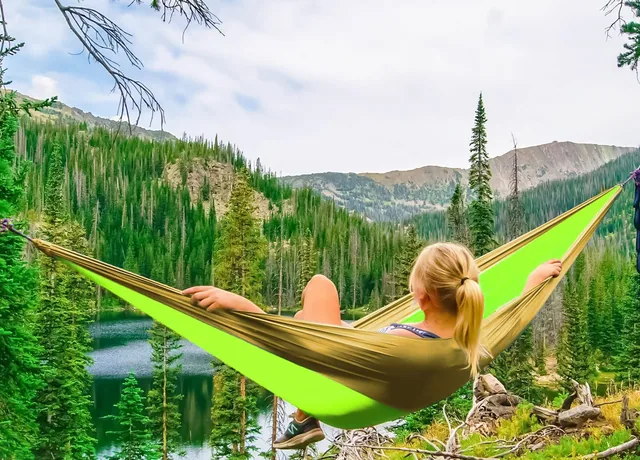
Pick two living trees at least 6 inches across, wrap each with a wide strap once, clip the hammock to a loop that leaves it hanging loose, and keep it under 5 feet off the ground. If you have no trees the right distance apart, or you want the hammock on a deck or a lawn, a steel stand does the same job with no trees at all.
A hammock is the easiest bed you will ever set up, and also the easiest to set up badly. Most of the trouble we hear about comes down to three things: trees too close or too far apart, straps cranked so tight the hammock sits flat like a drum, and a hang so high that getting in is a small adventure. All three are simple to avoid once you know the numbers.
This guide covers trees, straps and stands. The rules for trees come from Leave No Trace, the outdoor ethics group whose guidelines many parks and scout troops follow, and every rule below links to its source with the date we read it.
Start with the trees
The tree holds your weight, so choose it before you unpack anything. Look for two living trunks with firm bark, and look up as well as across. A dead branch overhead is a bigger risk than any knot or strap.
Select trees that are at least 6 inches in diameter, preferably with hard bark and no lichen.
Six inches across is a trunk you cannot close one hand around. Thinner trunks bend under two people, and bending trees can pull out of soft or wet ground. Hang on the thickest part of the trunk, low down, and skip trees with peeling bark or lichen, which tear easily and take a long time to recover.
Then measure the gap. You do not need a tape. Pace it out, counting roughly three feet a stride for most adults, and you will know within a foot or two whether the spot works.
How far apart should the trees be?
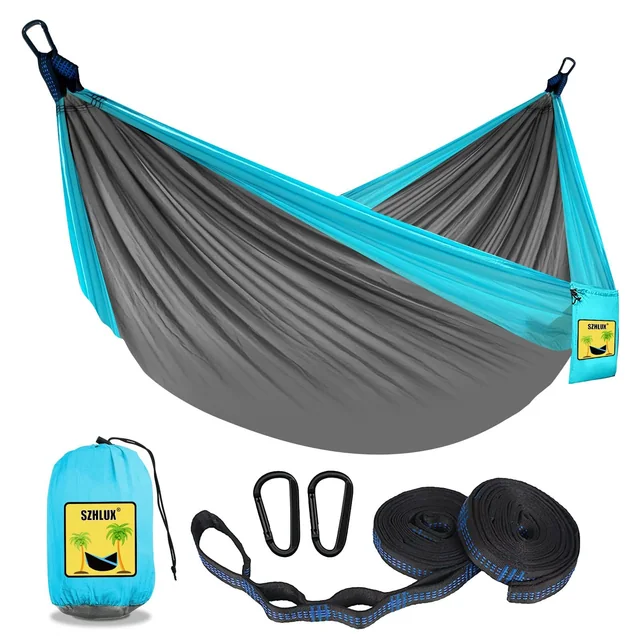
About 9 to 20 feet for our camping hammock with the two 10 ft straps in its box. The Medium is 106.3 inches end to end, which is about 8.9 feet.
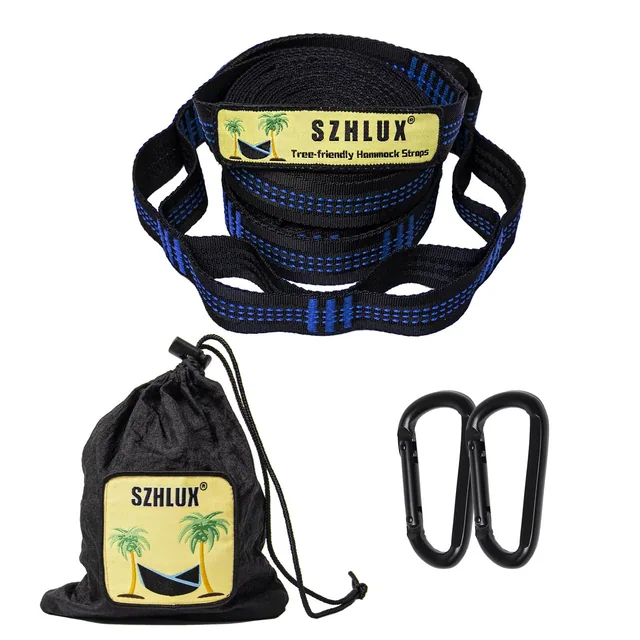
Each strap has 18 loops plus an end loop to clip into. Part of each strap wraps around the trunk, and the rest bridges the gap. Do the arithmetic and you get the window in the table.
| Point | What happens | What to do |
|---|---|---|
| Under 9 ft | The trees are closer than the hammock is long. It folds on itself and sits low. | Choose another pair of trees, or use a stand |
| About 9 to 20 ft | The hammock spans the gap and the straps take up the rest with loops to spare. | Clip into the loop that gives a gentle sag |
| About 20 to 23 ft | It still reaches, but the straps run long and thick trunks eat more of each strap. | Hang lower and test the sag before you sit |
| Over 23 ft | Two 10 ft straps cannot bridge the gap once they wrap the trunks. | Pick closer trees or set the hammock on a stand |
These ranges are our own working numbers from the hammock length and the strap length, not a rule from any agency. Thick trunks use more strap to wrap, so near the top of the range it pays to test first. Our hammock fit check on the home page runs the same arithmetic for any gap you type in.
A hammock with straps in the box, and spare straps for a longer reach
Medium or Large?
Medium, at 106.3 by 55.1 inches, suits one adult or an adult with a small child. Large, at 118 by 78 inches, suits two adults or one tall person who likes room to turn.
Both sizes use the same 210T parachute nylon and the same straps, so the choice comes down to who will lie in it and how much you want to carry. The Medium packs smaller and lighter, which matters on a long walk in.
The Large wins at a campsite you drive to, or in a backyard where two people share one hammock in the evening. Our double version is rated for 500 pounds, and the Medium for 400 pounds, and both figures cover the people in the hammock, not the people and the gear piled on top of them.
Setting it up, step by step
- Pick two living trees at least 6 inches across, with no dead branches above, and pace out the gap between them.
- Wrap one strap around the first trunk at about head height, feed the end through its own loop and pull it snug against the bark.
- Do the same on the second tree, at the same height, so the hammock hangs level.
- Clip each carabiner into a loop that leaves the hammock with a gentle curve, then press down on the middle with both hands before you sit.
- Sit in the center first, then swing your legs up and lie on the diagonal. If the hammock touches the ground, move both carabiners up one loop.
Taking it down is the same five steps in reverse. Stuff the hammock into its pocket first, then unhook the straps, so the fabric never drags on wet ground.
Use wide straps and a single wrap
Rope looks strong, and it is, but it cuts into bark. The living layer just under the bark carries water and food up and down the tree, and a thin cord squeezed around it can damage that layer for good. Leave No Trace is direct about what to use instead.
Use 1 inch or wider straps made out of webbing that go around the tree to minimize girdling and damage to the bark and cambium layer.
Flat webbing spreads the load across a wide band of bark. Wrap it around the trunk once, feed the end through its own loop, and pull it snug. You do not need a knot. Our straps come with a row of sewn loops, so you choose your height by choosing a loop and clipping the carabiner into it. Moving the hammock up or down a few inches takes seconds.
Check the width of any straps you use, ours included, against that 1 inch line. Narrow ratchet straps and cord do not belong on a tree.
Keep the hang loose and low
The instinct is to pull everything tight so the hammock lies flat. Resist it. A tight hang squeezes the bark, strains the straps and throws you out sideways, because a flat hammock has no curve to hold you in. A loose hang, with a smile-shaped sag, is kinder to the tree and far more comfortable.
Use a loose hang with the straps to prevent damage to the tree.
Lie in it on the diagonal, head toward one side and feet toward the other, and the fabric opens out flat under you. That is how a two-person hammock like ours gives one person a flat bed, and why a 55 inch wide Medium is roomy for one.
Height matters for safety. The bottom of the hammock should sit about where a chair seat sits when you are in it. Leave No Trace gives a ceiling for the hang.
It is recommended that you hang your hammock less than 5 feet off the ground to prevent accidents and to avoid damage to higher branches and leaves.

When a stand is the better answer
Trees are not always where you want to relax. A deck, a patio, a small yard or a beach has none in the right place, and some parks do not allow hammocks on their trees at all. A steel stand solves all of that, and it takes the tree question off the table.
Our stands come in three forms. The hammock with stand pairs a woven cotton hammock with a black steel frame rated for 450 pounds, and it goes together with no tools. The portable hammock with stand is rated for 500 pounds and adds balance straps that cut down side sway, plus chains to set the hanging height. And the 9 ft stand comes on its own, with hooks you can move to suit hammocks of different lengths.
| Point | Trees and straps | Steel stand |
|---|---|---|
| Where it works | Anywhere two healthy trees stand 9 to 20 ft apart | Decks, patios, lawns, sand, indoors |
| Weight to carry | About 1.8 lb packed, for the Medium | A frame you move by car, then set up in minutes |
| Rated load | 400 lb Medium, 500 lb for the double version | 450 lb, or 500 lb for the portable stand |
| Height control | Choose a strap loop | Move the hooks or adjust the chains |
| When it is the wrong choice | Thin, dead or wet-ground trees, or parks that ban hammocks | Backpacking, or any trip where you carry everything on foot |
For a deck or a yard without trees
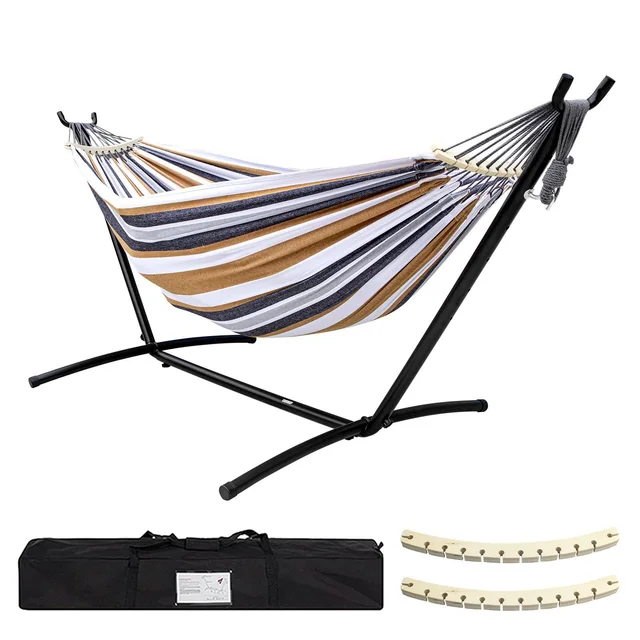
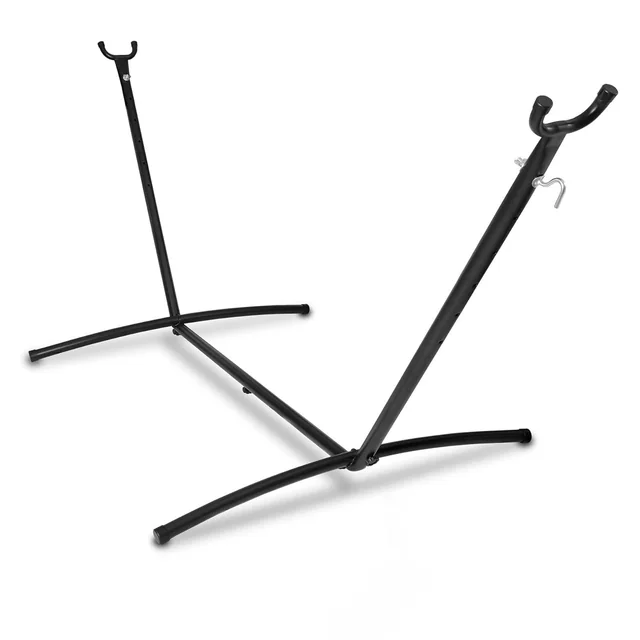
One measurement saves a return. Spreader-bar hammocks are long. Our quilted hammock with spreader bars runs 141 inches from loop to loop, so measure the stand you plan to use before you order, or pair it with a stand built for that length. The hammock comes with a plain request for exactly this reason: measure your stand or space before you buy.
Set a stand on flat, firm ground. Keep it clear of steps, pool edges and the edge of a deck, and check that every foot sits level before anyone climbs in. On grass, the feet can sink after rain, so give the frame a push now and then and reset it if it leans. Our stands come apart for winter, which keeps the steel out of the snow and the cotton out of the damp.
Check the rules where you go
Before a trip, look up the rules for the park or forest you are heading to. Some ask hammock users to stay on established sites, some ban hanging from trees in busy areas, and a few ban it outright.
Some state and local parks, for instance, prohibit hanging hammocks so double check to avoid breaking the rules and creating unnecessary impacts.
The same guidelines ask hammock campers to set up at least 200 feet from lakes and streams and to choose spots where the ground is already bare. They also ask you to take the hammock down whenever you leave camp, so animals and children do not get tangled in it. All of that is easy with a hammock that packs into its own pocket.
Hammocks for children
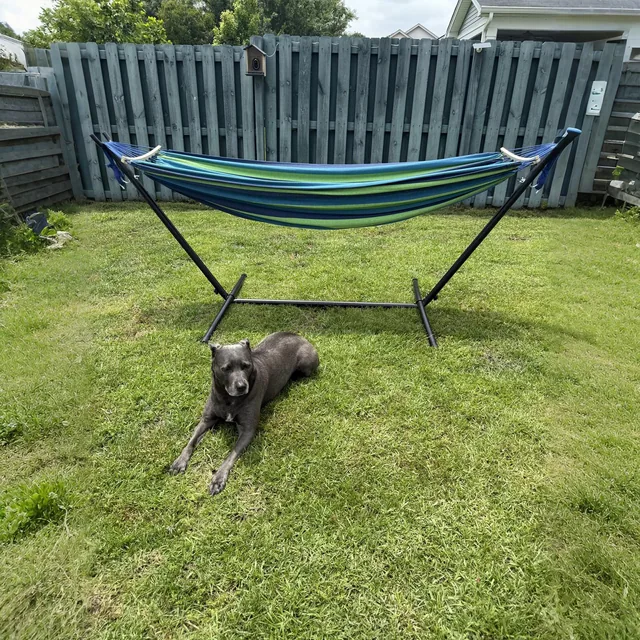
Our kids hammock is 6.5 by 3.3 feet and weighs 1.5 pounds. It comes with the same 10 ft tree straps with 18 loops plus an end loop, so an adult can set it low. Hang it low enough that small feet touch the ground when they sit on the edge, and stay close while they use it. The guidance about trees, wide straps and a loose hang applies just the same.
Care and storage
The 210T parachute nylon in our camping hammocks shrugs off dirt and dries fast after rain. Shake out leaves and sand before you pack it, and let it dry fully before it goes back in its sack for the winter. Check the stitching and the carabiner gates at the start of each season, and retire any strap that shows cuts or fraying. Cotton hammocks on stands are softer and warmer to lie on, and they also take longer to dry, so bring them in when a storm is coming.
What a hammock will not do
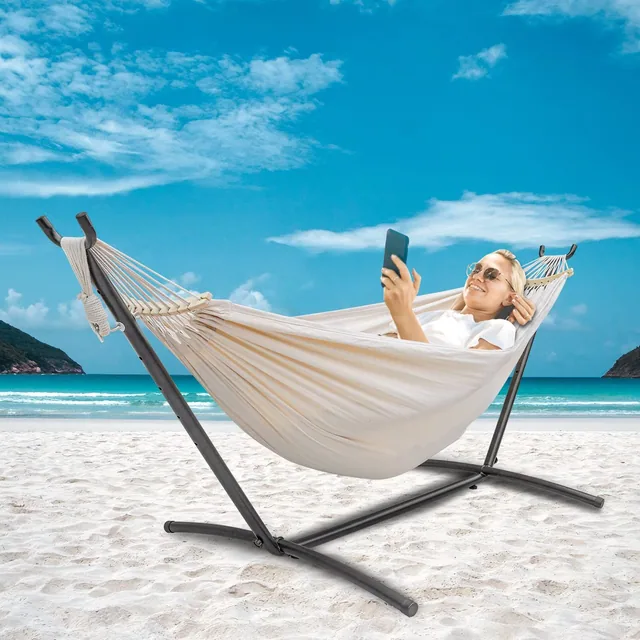
A camping hammock is not a stand, and it cannot hang where there are no trees. A stand is heavy to carry and has no place in a backpack. A two-person hammock holds two people side by side, but two adults will not both lie flat in it. And no strap makes a dead tree safe. Choose the setup for the place you will use it most, and the rest is easy.
You can see every SZHLUX hammock, stand and strap in hammocks and stands, and our folding chairs and wagons in patio and camp.
Sources
- Leave No Trace. How to Hammock Camp Responsibly (2025 guidelines). Read 27 October 2026.